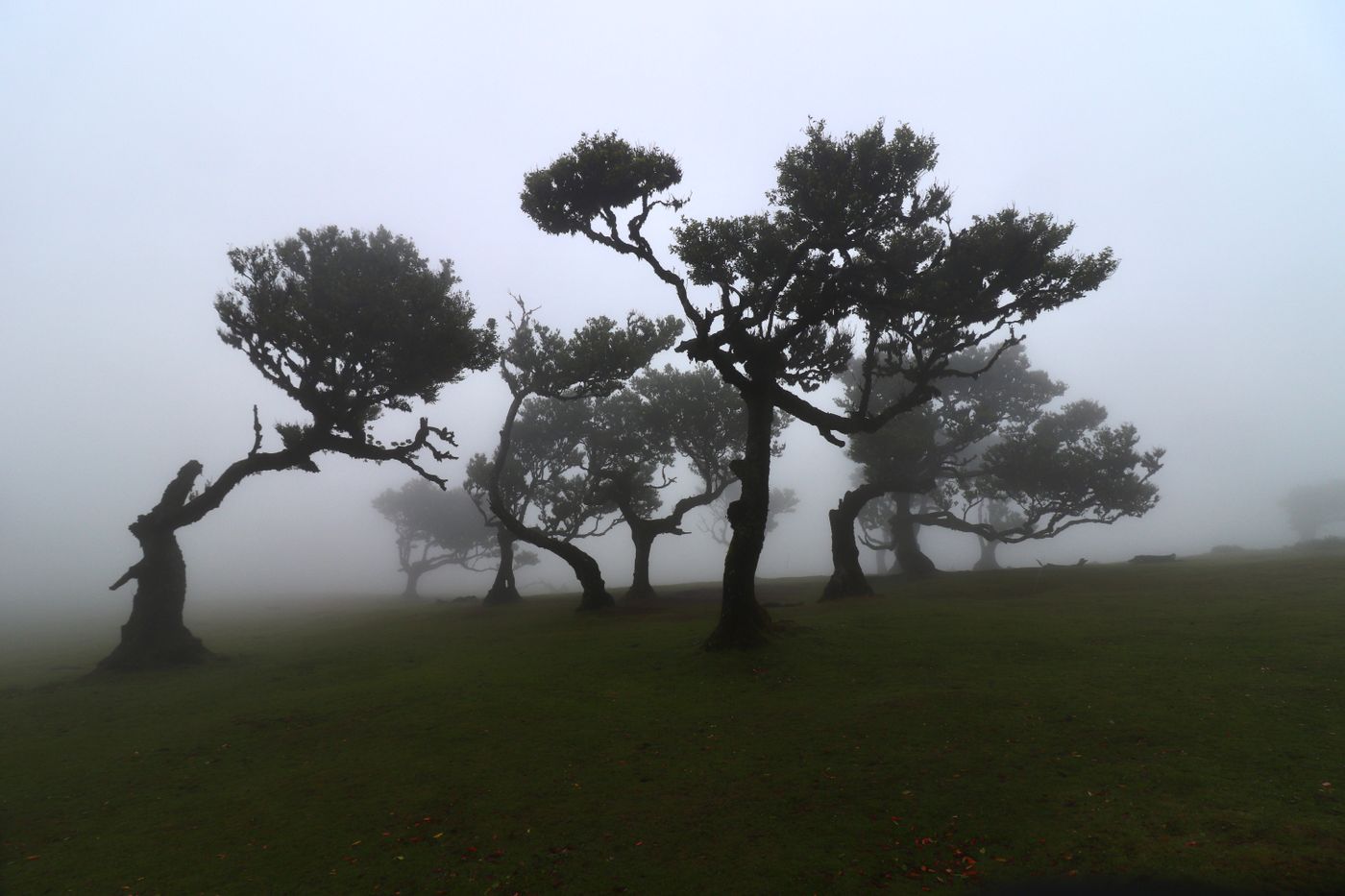
Fanal on a grey morning. The cows are somewhere in there.
Forest · 1150 m
The laurel forest and Fanal
The trees on the cover are not props. They are the last large stand of a forest that once covered much of southern Europe, and Madeira is where it held on.
Most of what makes Madeira green is older than you think. The laurisilva — the laurel forest that drapes the north slopes and the high spine of the island — is a leftover. Around twenty million years ago, forests like this ran across the Mediterranean basin and a good slice of southern Europe. The climate dried out, the ice ages came and went, and the laurel forest died off the continent almost completely. Out here in the Atlantic, on a wet island that traps cloud against its mountains, it never had to leave.
That is the short version of why people fuss over it. A longer version involves a UNESCO listing, a pigeon that exists nowhere else, and a meadow full of trees that look like they were drawn for a film.
A forest that should not still be here
The Laurisilva of Madeira was inscribed as a UNESCO World Heritage Site in 1999. It covers roughly 150 square kilometres, mostly on the cooler, cloud-fed north side and the centre of the island, and it is the largest surviving area of laurel forest on the planet. A large share of it has never been cleared, which is rare for any forest in Europe, let alone one this old.
Its trees are not famous names. The Madeira laurel does much of the work. So does the til, Ocotea foetens, which can grow huge and live for centuries and is what you are looking at in most of the moody Fanal photographs. Vinhático fills in alongside them. None of these are giants in the redwood sense; the appeal is age and shape and the sheer density of green, not height.
The forest also keeps the island running, more or less literally. Rain and fog drip off the canopy, soak into the slopes, and feed the springs that the levadas — Madeira's network of irrigation channels — carry down to the farms and towns. Walk a levada on the north side and you are usually walking through laurisilva, with water on one side and a wall of moss and fern on the other. The laurel forest is not scenery bolted onto the island. It is part of the plumbing.
Fanal, and the fog
Fanal is the part everyone has seen, even if they did not know the name. It sits up on the Paúl da Serra, the high plateau in the west of the island, at around 1,150 metres. It is not a dense forest there. It is closer to high pasture — open grass with old, low til trees scattered across it, their trunks fat and twisted, their crowns spread wide. Cows graze among them. On a clear day it is pretty and a little ordinary.
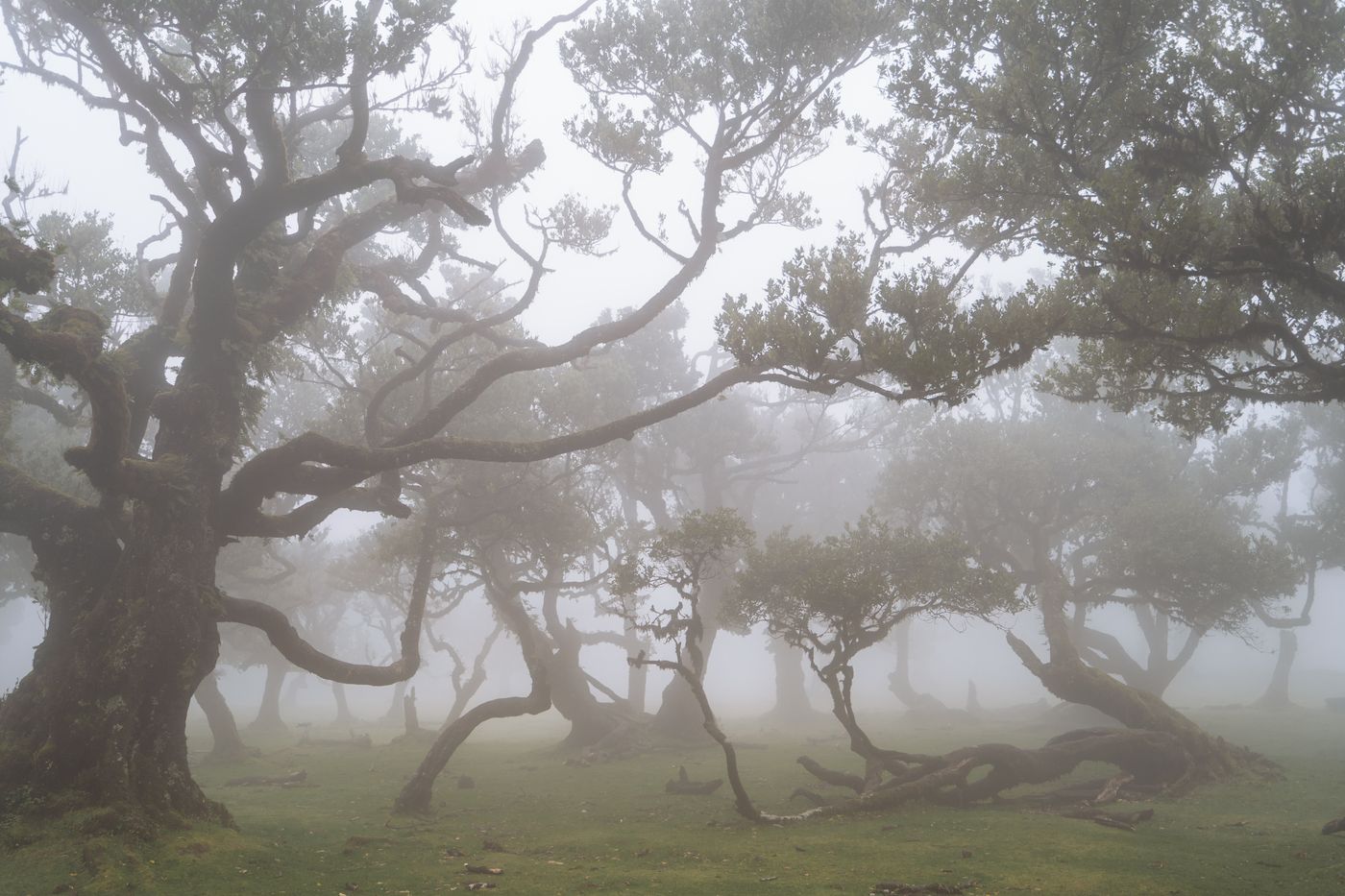
Then the cloud comes in. This plateau catches it constantly, and when the fog settles the place changes completely. Trees lose their backgrounds, the grass goes soft and grey, and the whole meadow turns into the dreamlike scene that fills photographers' memory cards. It is genuinely eerie, in the good way. The catch is that the same fog that makes it beautiful also makes the drive up there slow and occasionally nerve-wracking.
The weather that ruins the view is the weather that makes the view. You cannot really have one without the other.
A few honest notes. There is no guarantee of fog; some days it sits clear for hours. The light is best early or late, and the crowds are thinnest then too. And the famous trees are a small cluster near the road and the old forestry house, not a vast forest you wander for miles. Manage the expectation and you will not be disappointed. For current access and any seasonal notes, the official Madeira tourism site is the place to check.
Other ways into the forest
If Fanal is the postcard, the working forest is easier to reach elsewhere, and frankly more interesting to walk in.
- Queimadas — a thatched-roof forestry park near Santana, all moss and old laurels, and the start of several of the north's best levada walks.
- Ribeiro Frio — a small spot on the road over the mountains, with a trout hatchery, a short nature trail, and the path to the Balcões viewpoint.
- Balcões — an easy, mostly flat levada walk out to a balcony of rock with a long view into the central valley. Good legs not required.
Two ways to do the whole thing. Drive to Fanal, accepting the slow mountain roads and the chance of cloud, for the trees-in-fog photograph. Or pick a levada on the north side and walk straight into the living forest, where the canopy closes over you and the only sound is water moving. The second one tells you far more about why this place got its UNESCO listing.
Tread lightly
This is a fragile habitat and a protected one. Stay on the marked paths and levada walkways — the forest floor and the mosses recover slowly, and the slopes are steep and unstable off-trail. Take your rubbish back out. At Fanal, the trees are old and the roots sit close to the surface, so keep off them however good the photo would look from up there. The forest survived twenty million years and a continent's worth of climate change. It can survive us too, if we behave.
For the background on Fanal itself — the laurisilva pocket, the plateau, the way the fog forms — the Fanal forest entry is a decent starting point before you go.