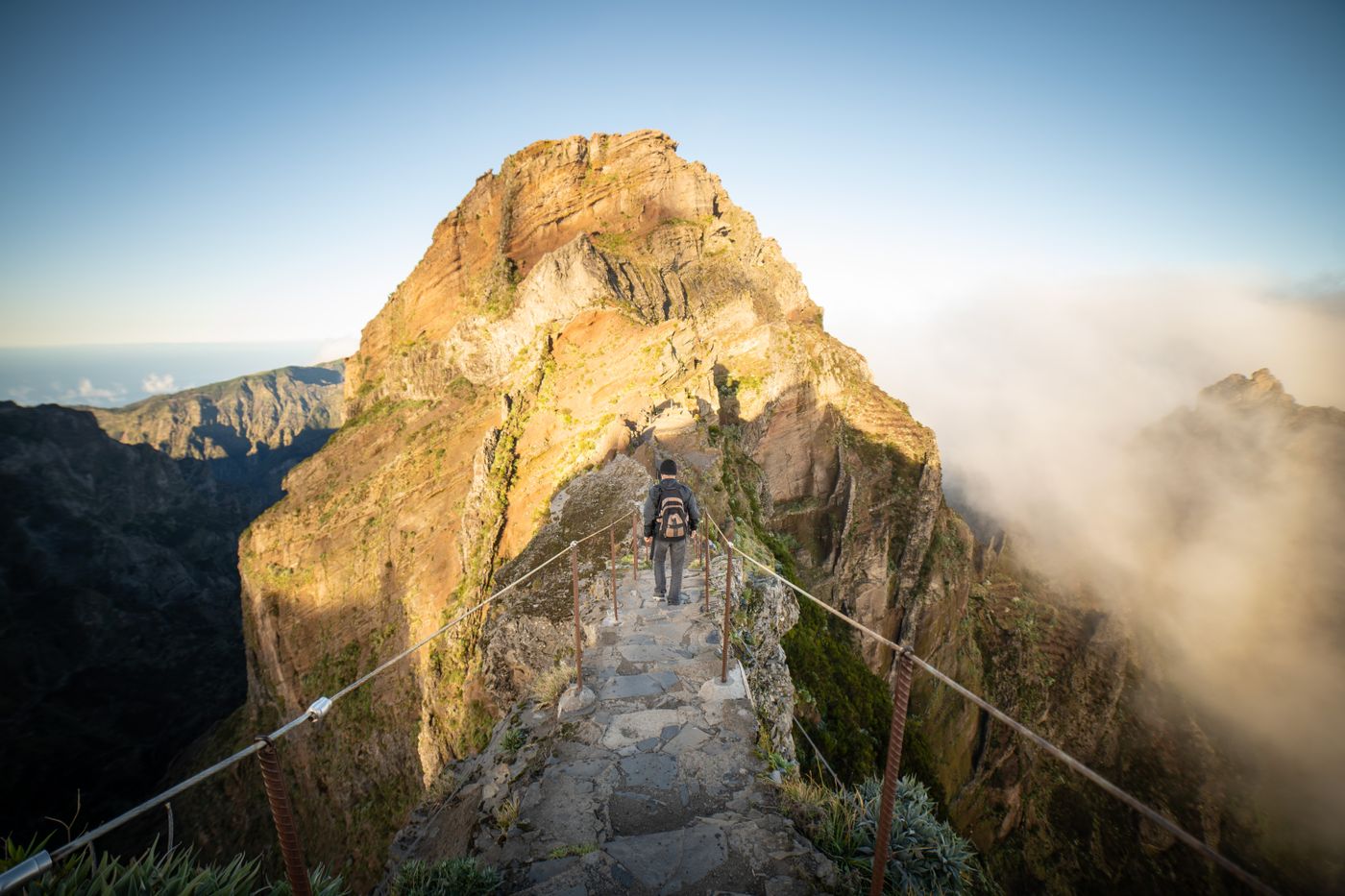
The PR1 below Pico do Arieiro: cut steps, a thin cable, and cloud waiting to swallow the right-hand drop.
Peaks · 1818–1862 m
Pico do Arieiro to Pico Ruivo
The PR1 links Madeira's third-highest peak to its highest along a knife of volcanic rock that spends half its life poking through cloud. It is the finest day the island gives you on foot, and the one people most often underestimate.
Most great walks have a dull bit at the start. This one doesn't. You step out of the car park at Pico do Arieiro, at 1,818 metres, and the path immediately drops away into a world of red rock, green slopes, and a flat white floor of cloud somewhere below your boots. The summit of Pico Ruivo, the highest point on the island at 1,862 metres, sits a few jagged peaks away across the ridge. There is no road to it. The only way up is to walk.
That's the whole appeal. Arieiro you can drive to, and plenty of people do — for sunrise, mostly, when the eastern sky goes copper and the cloud sea catches the light. Ruivo you have to earn. The trail between them, signposted PR1 and named the Vereda do Areeiro, is short on a map and long underfoot.
At a glance
- Distance
- ~7 km one way (Arieiro to Ruivo)
- Ascent / descent
- Several hundred metres each, in repeated up-and-down steps; the sting is in the constant climbing, not one big push
- Time
- 3–4+ hours one way; 6–7 hours out-and-back, longer with photo stops or queues
- Grade
- Hard — exposed, cabled sections, dark tunnels, relentless stone steps
- Start
- Pico do Arieiro car park (road-accessible, free parking, café)
Seven kilometres that feel like twelve
Distance is the trap here. Seven kilometres sounds like a stroll. Almost none of it is flat, though. The PR1 climbs over the shoulder of Pico das Torres between the two named summits, which means you descend hundreds of stone steps, then climb hundreds more, then do it again. Quads first, knees on the way back. By the time you reach the foot of Ruivo's final climb, your legs have already done a full day's work.
It is genuinely steep in places, too. Some sections narrow to a ledge with a sheer drop on one or both sides, and the only thing between you and the valley is a steel cable bolted into the rock. None of this requires climbing skill. What it does require is a head that doesn't mind heights and feet that watch where they land. In the wet, stone gets slick and those cables become more than decorative.
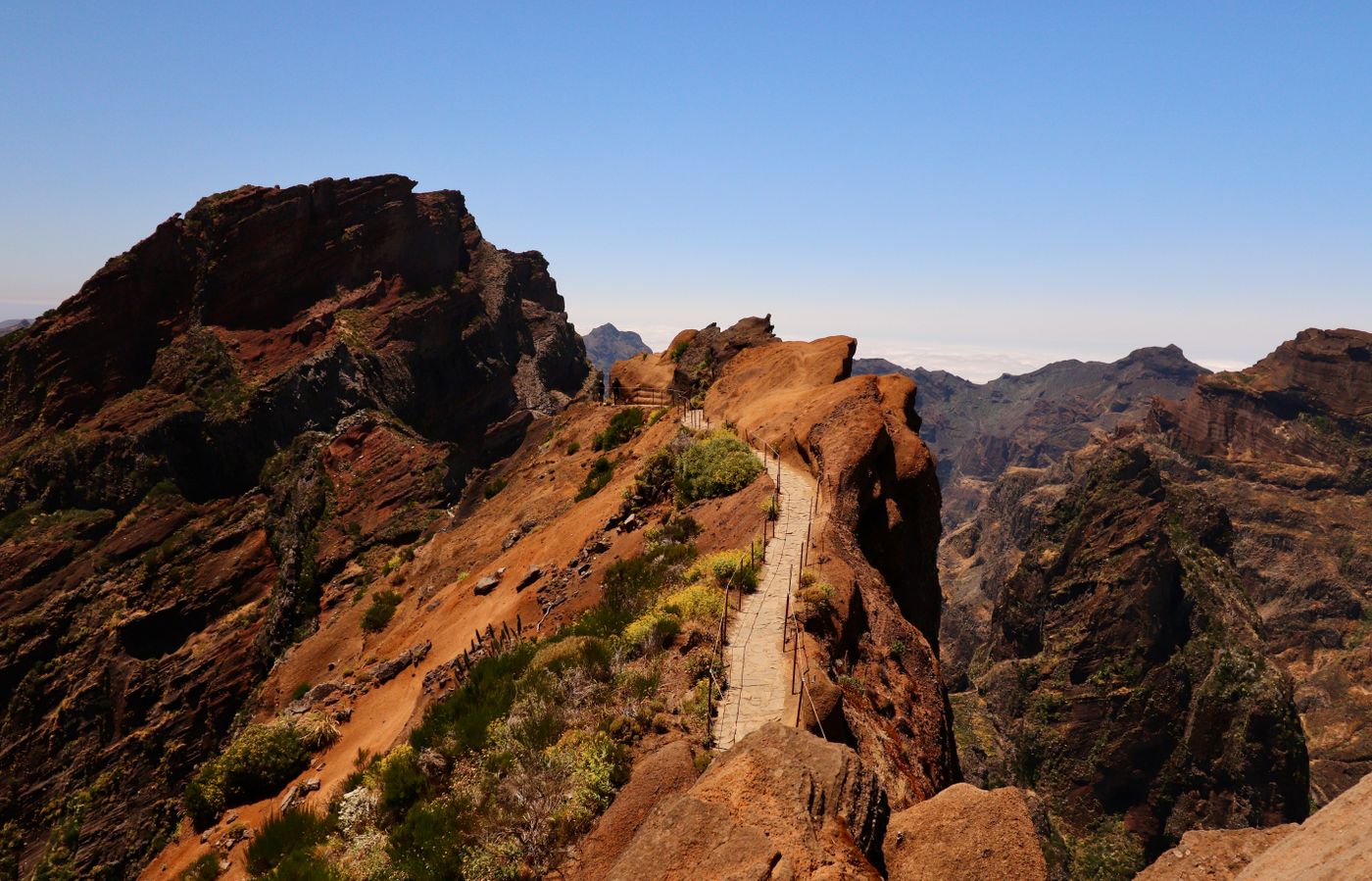
The tunnels — bring a torch, and mean it
The detail nobody warns you about until you're standing in front of one: the PR1 runs through several tunnels blasted straight through the rock. A couple are short enough to see the far end. At least one is long, curved, and properly dark — phone-light-feels-feeble dark, water dripping from the ceiling, the floor uneven underfoot. People shuffle through with their hands out, laughing nervously.
A phone torch works at a pinch. A real head-torch is better, because it leaves your hands free for the wet rock and the cables that sometimes run inside the tunnels too. Don't treat it as optional. Walking the longest tunnel by the glow of a dying phone, with a stranger's elbow somewhere near your ribs, is exactly the sort of thing that turns a brilliant day into a stressful one.
Pack for the ridge
- Head-torch
- For the tunnels — non-negotiable
- Layers
- Wind shell plus something warm; the summit is cold even in July
- Water
- 1.5–2 litres; there is none on the trail
- Footwear
- Proper boots or grippy trail shoes, not sandals
Weather, and the discipline to turn around
At this height Madeira keeps its own weather, and it changes fast. You can leave Funchal in shorts under a blue sky and reach Arieiro to find cloud streaming over the ridge at speed, the temperature ten degrees lower, and a wind that shoves you sideways. Cold, wet, white-out conditions happen in midsummer. They are normal, not freak events, and visitors who only checked the coastal forecast get caught out every season.
Why does that matter so much? Because the same exposure and stone steps that make this walk thrilling in clear weather make it dangerous in bad. When cloud closes in, the drops you can no longer see are still there. Sections of the PR1 also get closed by the forestry authority after rockfall, storm damage, or repair work, and those closures exist for good reasons rather than to spoil anyone's holiday.
Start early, read the sky, and accept that the summit is optional. The mountain will still be here next trip.
So the rule is dull but firm: check the forecast for the peaks specifically — not Funchal — the evening before and again that morning. Confirm the trail is actually open through the official channels before you commit, since the published forestry and conservation status for these routes can change overnight. And once you're walking, if the cloud comes down and the wind gets up, turn around without sulking about it. The summit is optional. Getting back to the car is not.
One way, or there and back?
You've got a decision to make about logistics. Walking the full ridge one way, Arieiro to Ruivo, is the classic line — but it leaves you on the wrong mountain, with no road, several kilometres from your car. Plenty of people solve that with a pickup: they arrange to be collected from Achada do Teixeira, the road-head on the far side of Ruivo, and walk down to it after tagging the summit.
Retracing the PR1 the whole way back to Arieiro is the purist's option, and the brutal one. You repeat every step, every tunnel, and every cabled ledge, this time with tired legs. Budget six to seven hours and expect the return to feel longer than the way out.
It is, frankly, a lot of stairs to do twice.
There's also a softer way to reach the top of the island that skips the drama entirely. From Achada do Teixeira a much gentler path (the PR1.2) climbs to the Pico Ruivo shelter in roughly forty-five minutes to an hour each way, no tunnels, far less exposure. If the high ridge is closed or the weather's wrong, that's how you still stand on the summit and keep your dignity.
Sunrise on Arieiro
The reason the car park fills before dawn is the view from Pico do Arieiro itself, which you get without walking a step. On a good morning the sun comes up over a sea of cloud that hides the entire coastline below, with only the highest peaks breaking the surface. It is genuinely one of the better sunrises in this part of the Atlantic, and it's busy for a reason.
A lot of visitors drive up in the dark for the sunrise and stop there — peak, photos, coffee, back down. Doing the sunrise and then continuing along the PR1 is a long, cold, brilliant day, but it does mean being on exposed ground for hours from first light. If that's the plan, the layers and the torch matter even more. The island's tourism board keeps current notes on conditions and access at visitmadeira.com, worth a glance before any early start.
Is it worth it?
Yes, with one honest caveat. In clear, calm weather the Arieiro–Ruivo ridge is the best few hours Madeira gives you, the kind of walk you describe to people for years afterwards. In bad weather it's miserable at best and risky at worst, and there's no shame in saving it for another day. This is a mountain that rewards patience more than determination.
So treat the seven kilometres with respect. Carry the torch, watch the sky, and don't be the person who pushes on into the cloud because the flight home is tomorrow. Walked on a good morning, with the cloud floor below and the peaks burning orange ahead, it earns every superlative people throw at it.