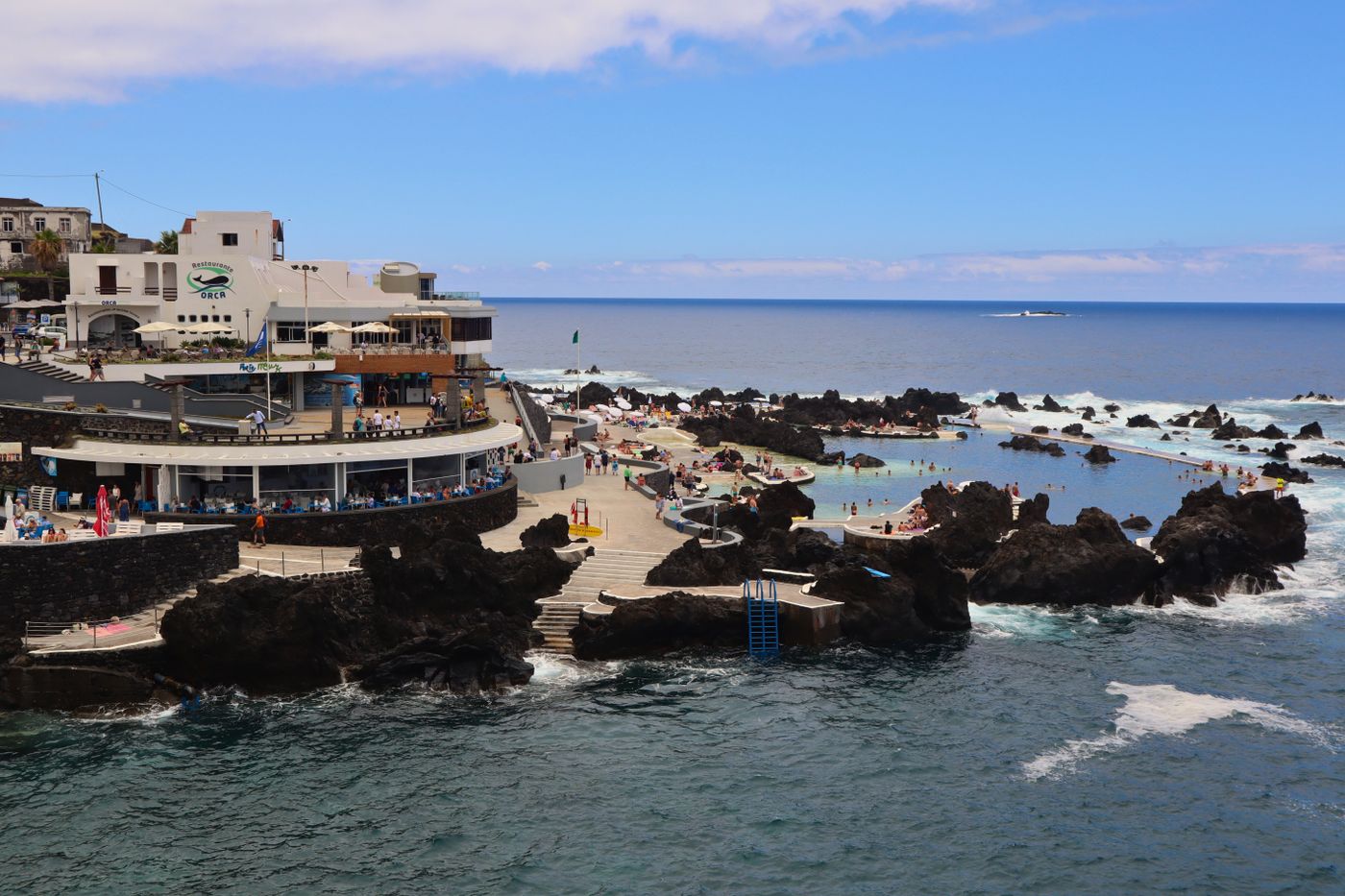
Porto Moniz: lava-rock pools the Atlantic refills, with the open ocean a few metres past the far wall.
Coast · sea level
Porto Moniz and the northwest
Madeira's far corner is wet, green and loud with surf. You come for the volcanic swimming pools, but the road to reach them is half the reason to go.
Most of Madeira sells itself on sun. The south coast, around Funchal and Calheta, is dry and bright and built for it. Drive over the spine of the island to the northwest and the weather changes within a single tunnel. Cloud snags on the peaks, the cliffs go a deeper green, and water runs off everything. Porto Moniz sits at the very tip of that corner, where the Atlantic arrives with nothing in front of it for thousands of kilometres.
It is a small village. A few streets, a scatter of restaurants, a harbour, and the thing everyone drives out here to see: pools made of lava.
The pools, and which set is which
When a lava flow met the sea here, it cooled into a knot of black rock full of basins and channels. Those basins hold seawater, and the swell tops them up over the outer wall. The result is swimming that feels open to the ocean but is shielded from the full force of it. There are two sets, and people mix them up.
First is the managed complex on the western side, the one in most photographs. It has been tidied with concrete walkways, steps, ladders and handrails laid over the rock, plus changing rooms, a café and lifeguards in season. Entry costs a few euros, paid at a kiosk. Water is clear and cold, the floor is uneven volcanic stone, and the deeper parts drop off faster than you expect.
A second set sits a short walk east, below the village. These are free, wilder and less groomed. No ladders to speak of, no kiosk, fewer people, and the swell comes through harder. On a calm day they are wonderful. On a rough day they are not a place to be.
Either way, the appeal is the same. You are floating in clear water with black rock around you and white surf breaking on the far side of a low wall, close enough to feel the spray. It is not a warm-bath experience. The Atlantic here runs cool most of the year, which is part of why it stays so clear.
The wall between you and the open ocean is about a metre high. That is the whole pitch of Porto Moniz, and it works.
Getting there is the point
You can now drive from Funchal to Porto Moniz in well under an hour and a half, mostly through tunnels and on the fast road across the centre of the island. It is efficient and slightly dull. The better way, with time and a car, is to come along the north coast and take the long road in.
That coast road threads under cliffs that rise straight out of the water, with terraced smallholdings clinging to whatever ground is flat enough. The newer road runs through tunnel after tunnel. The older sections, the ER101, are still drivable in places and were famous for one thing: waterfalls that fell out of the cliff and onto the tarmac. You drove through them. The most photographed is the São Vicente end of the run, near the Véu da Noiva, the "Bridal Veil," which spills down the rock toward the sea. Most of those old stretches are now bypassed and some are closed for safety, but the lay-bys and viewpoints still let you stand and look.
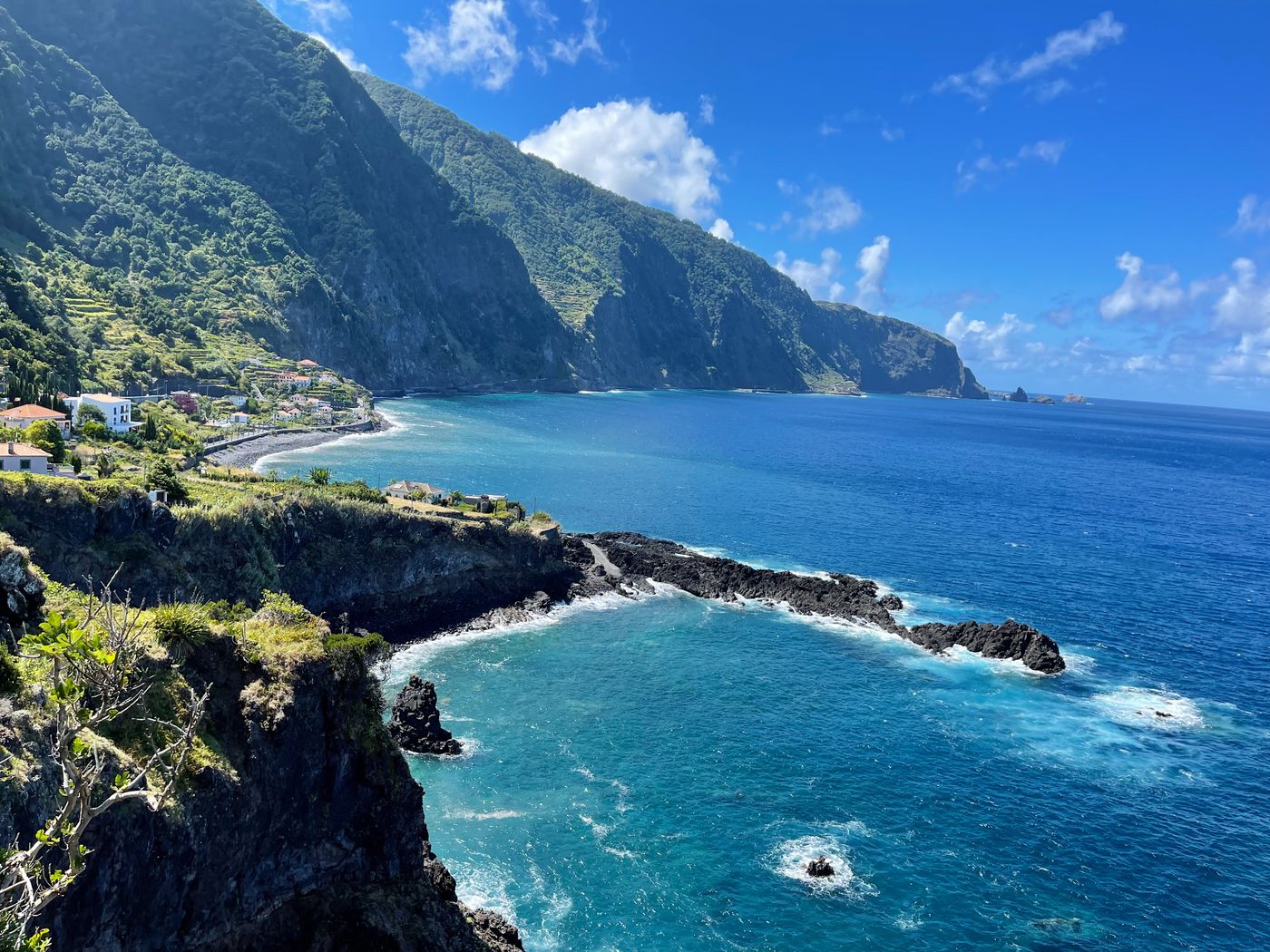
Seixal, the village I keep stopping at
Roughly halfway between São Vicente and Porto Moniz is Seixal, and I have never managed to drive past it without pulling over. The cliffs behind the village are streaked with thin waterfalls after rain, vivid green, almost too much. The place has its own small natural pool, quieter than Porto Moniz, and a black-sand beach, Praia do Porto do Seixal, tucked under the headland. The sand is properly black, volcanic, and warm underfoot when the sun is out.
It is a working village, not a resort. A few cafés, a small harbour, and people going about their day. That is exactly why it is worth the stop. Twenty minutes here is a better souvenir than another car-park photo at the main pools.
São Vicente and going underground
Coming from the east, São Vicente is the gateway to this whole stretch. The centre is tidy and walkable, with a small old church and a river running down to the sea. Just inland are the Grutas de São Vicente, lava tubes left by an old eruption. A flow cooled on the outside while molten rock kept draining through the middle, and when it emptied it left these tunnels. The guided walk through them is short and genuinely interesting, and the attached volcanism centre explains how the whole island was built, which makes the pools at Porto Moniz read differently once you have seen it.
If you only have a day and you are choosing, I would still point you at the pools and the coast over the caves. But if it is raining hard, and on this coast it might be, the lava tubes are a good place to be dry for an hour.
The cable car at Achadas da Cruz
West of Porto Moniz, up on the plateau, is one of the island's stranger rides. At Achadas da Cruz a small cable car drops down the cliff face to a fajã, a flat shelf of land at the foot of the rock that is otherwise almost impossible to reach. People still farm small plots down there and keep boats. The descent is steep and a little hair-raising, the platform at the bottom is tiny, and there is not a great deal to do once you arrive beyond stand on the shelf and look back up at where you came from. That is the appeal. It is cheap, it is quick, and almost nobody who hasn't read about it ends up there.
How to plan the day
This corner is a full day, not a quick detour. With a car, the loop more or less writes itself: cross to the north coast, come along through São Vicente and Seixal with stops, swim at Porto Moniz in the middle of the day, and either carry on west toward Achadas da Cruz and Ponta do Pargo or turn back over the centre for home. Without a car, a west-side tour will usually fold these places into one circuit, which is the easy way if you would rather not drive the cliff road yourself.
A few honest expectations. The weather up here does what it likes, and a grey, drizzly Porto Moniz is a real possibility even when Funchal is in shorts. Bring a layer. The water is cold. And the sea, not the timetable, decides whether you swim. I have driven all the way out, found the pools roped off in a big swell, and had a perfectly good afternoon anyway, standing on the wall watching the Atlantic try to climb over it. For more on the island as a whole and how the wet north sits against the dry south, the official tourist board at visitmadeira.com is a reasonable starting point, and the overview of Porto Moniz itself fills in the history.
Go for the pools. Stay for the cliffs. This is the green, dripping, surf-battered Madeira that the brochures from the south never quite show you, and it is the one I would send a friend to first.