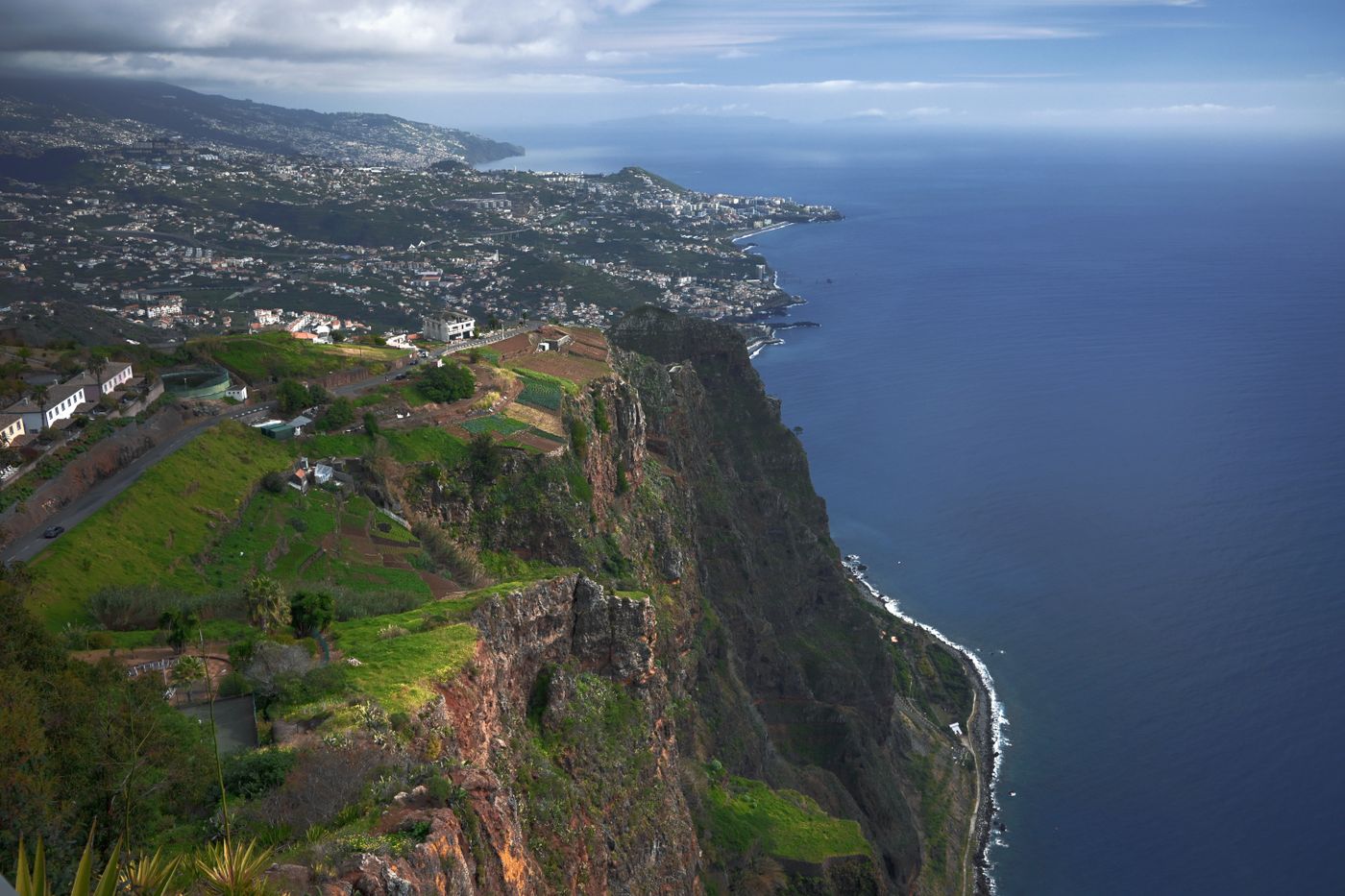
Cabo Girão from the clifftop: terraced fields run right to the edge, then nothing for the better part of 600 metres.
Coast · 580 m
Cabo Girão and Câmara de Lobos
A cliff with a glass floor, and the fishing village below it where the island's drink was invented. The two sit a few minutes apart on the coast west of Funchal, which makes them one of the easiest half-days you can put together on Madeira.
Most people do these two the wrong way round, or rather they do one and skip the other. They go to Cabo Girão for the photo, stand on the glass, feel their stomach drop, and drive off. The village down the coast gets left for another day that never comes. That is a shame, because the cliff and Câmara de Lobos make more sense together than apart, and you can see both properly in an afternoon.
Start with the height, since that is what everyone comes for. Cabo Girão is one of the highest sea cliffs in Europe, the rock face dropping somewhere around 580 metres straight into the Atlantic. The exact figure shifts depending on which point you measure, but the number is not really the point. The point is the feeling of standing at the top with the water that far below you.
The glass floor
The reason to come is the skywalk. Someone bolted a semicircular platform out over the edge and floored part of it with glass, so you walk out, look down through your feet, and there is the sea doing whatever the sea is doing 580 metres beneath your shoes. It is a simple trick and it works on almost everyone. I have watched grown men shuffle to the rail and refuse to step onto the clear panels, which is half the fun of being there.
It is free to visit, and that has consequences. Coach tours stop here, so the platform can get crowded by mid-morning, and getting a clear shot through the glass without somebody's trainers in it takes patience. The glass also fogs and scuffs, and on a cloudy day the drop below you can vanish into white, which is either a relief or a let-down depending on your nerves. Go early or go late.
Look over the side, past your own feet, and you will see the thing most visitors miss entirely. Far below, at the base of the cliff, there are narrow green terraces wedged between the rock and the waterline. These are the fajãs, flat pockets of farmland built up over centuries on land that fell or washed down from above. People still grow things down there. For years the only way to reach the plots was by boat. Since the early 2000s a cable car runs down the cliff face so the farmers can get to their crops without a sea journey, which has to be one of the more dramatic commutes in Europe.
Down to the village
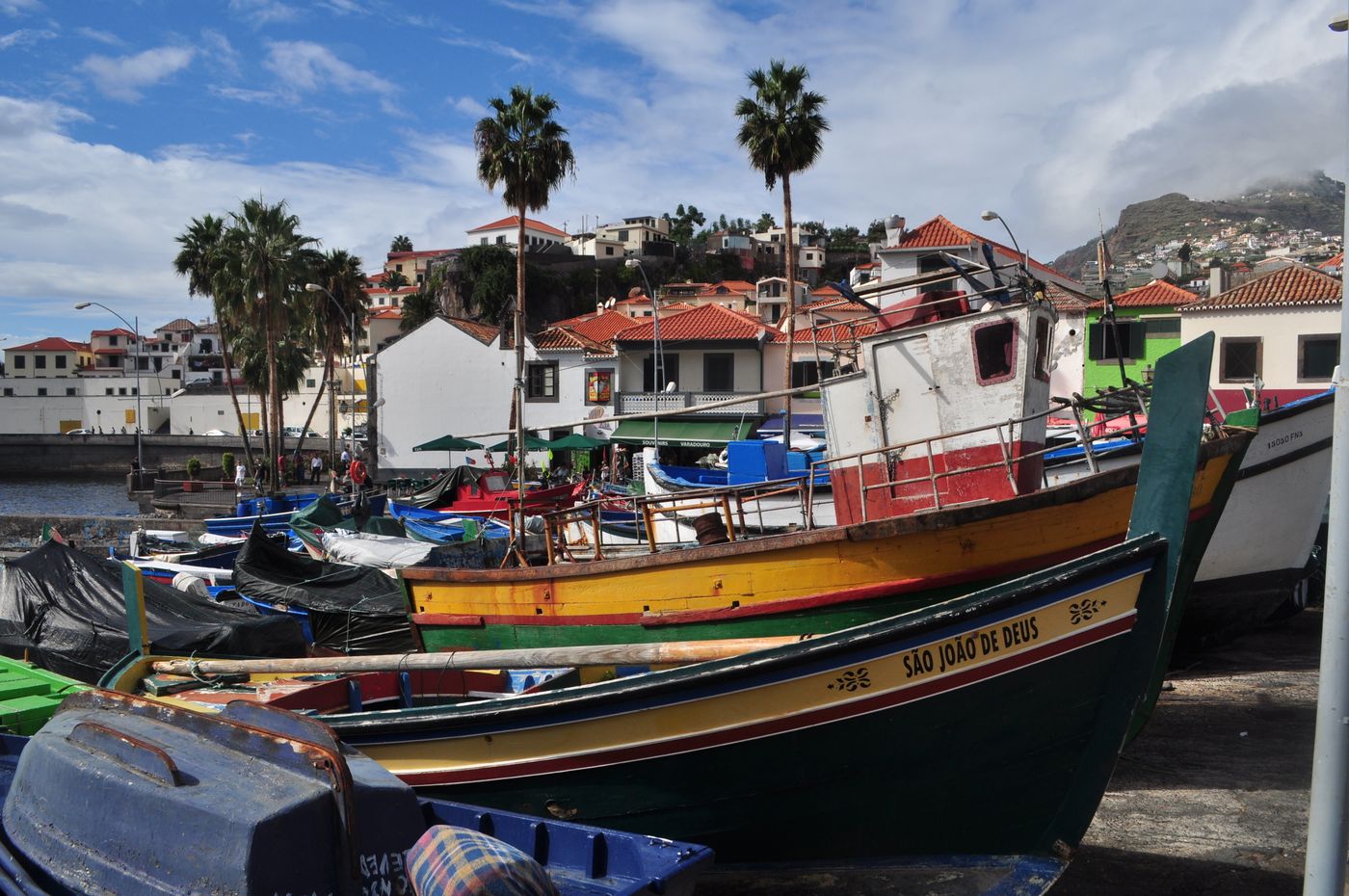
From the cliff it is a short drop down the coast toward Funchal to Câmara de Lobos, and the change of scale is the whole appeal. You go from a 580-metre void to a small bay crammed with wooden boats painted in colours that look chosen by someone in a very good mood. This is a working fishing harbour, not a stage set, even if it photographs like one.
The name tells you who got here first, and it was not the fishermen. When Zarco and his crew landed in 1419 the sheltered bay was full of monk seals, and they named the place for them. Lobos is the Portuguese for seals, the "sea wolves," and Câmara de Lobos is roughly the den or chamber of the wolves. The seals are long gone. The name stuck.
A small bay crammed with wooden boats painted in colours that look chosen by someone in a very good mood.
Churchill set up his easel here
The village has one famous visitor it will never stop mentioning. Winston Churchill came to Madeira in early 1950 and painted Câmara de Lobos from the waterfront, drawn by the boats and the light. There is a spot marked near the seafront where he is said to have set up, and a fair number of cafés trade on the connection. Worth knowing, not worth planning your day around. Have a coffee, look at the same boats he did, move on.
One honest glass of poncha
Here is the real reason a drinks writer would send you to Câmara de Lobos rather than anywhere else on the island. This is the spiritual home of poncha, and the little bars around the harbour pour it the way it was meant to be poured.
Poncha is built from aguardente de cana, the local sugarcane spirit, muddled together with honey and lemon. There are fruit versions now, passion fruit and orange and tangerine, but the original is the lemon-and-honey one, sometimes called poncha à pescador, the fisherman's poncha. It was the fishermen's drink, knocked back before heading out into the cold dark to set their lines. You make it with a grooved wooden muddler called a caralhinho, worked in the glass to crush the fruit and bind everything together. Watching someone who has done it ten thousand times is part of the experience.
It is stronger than it tastes, which is the trap. The honey and citrus hide the spirit completely, and the glass goes down like a soft drink. One is a pleasure. Two is a decision. Three and you are not driving back to Funchal, and you certainly should not have gone up to a cliff edge afterwards. My honest advice: have one good poncha here, made in front of you, and leave it at that.
While you have a glass in your hand, look at what is coming off those boats. The catch this coast is known for is espada, the black scabbard fish, a long ribbon of a creature with eyes like dinner plates that lives in deep water and looks frankly alarming on the slab. It tastes far better than it looks, usually fried with banana, which sounds wrong and is right. The boats in the harbour are the ones that go out for it.
Doing both in an afternoon
The pairing is the easy part. Cabo Girão and Câmara de Lobos sit within a few minutes of each other on the coast west of Funchal, close enough that there is no reason to choose. With a car it is a relaxed half-day: cliff first while the light is good and the coaches have not arrived, then down to the village for lunch, a glass of poncha, and an hour wandering the harbour. If you are not driving, plenty of organised half-day trips out of Funchal stitch the two together with a stop at each, which solves the poncha-and-driving problem neatly.
Go up top for the drop, come down to the water for the rest. The cliff gives you the view you will show people back home. The village gives you the afternoon you will actually remember. For opening details and the wider south coast, the official Madeira tourism site is the place to check before you set out.
If you want to read further on any of it, the background on Cabo Girão and on Câmara de Lobos is solid, and there is a surprisingly detailed entry on poncha if you want to argue about the correct recipe later.