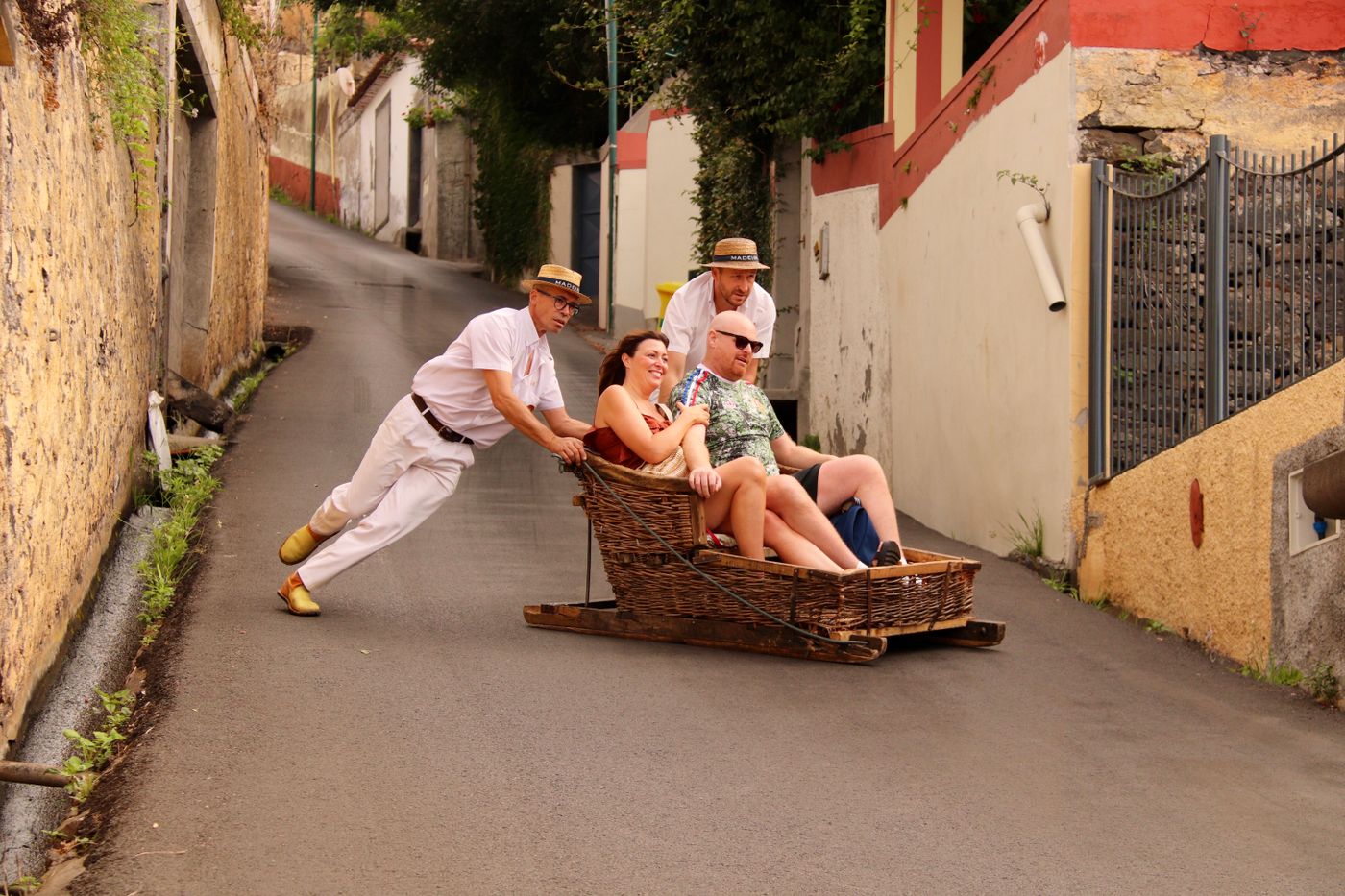
Two men in white, straw hats, leather boots, and a greased wicker basket. This is public transport's strangest descendant.
Funchal · 550 m
Monte and the toboggan
The hill village above Funchal gives you a cable car with a view, a church with a Habsburg emperor inside, a garden full of tiled panels, and a ride down the mountain in a wicker sledge. It is the most touristy thing on the island, and also one of the most genuinely odd. Do it once.
Monte sits roughly 550 metres above Funchal, close enough that you can see the bay from the church steps and far enough that the air feels different. For a long time it was where the city's well-off went to escape the summer heat, and the old hotels and quintas scattered through the hydrangeas still carry that faded-grand feeling. Today most people come for two reasons. They want the cable car up, and they want the toboggan down.
That combination is the standard run, and there is a logic to it. A cable car, the teleférico, does the climbing. You do the descent the silly way.
The cable car does the boring part
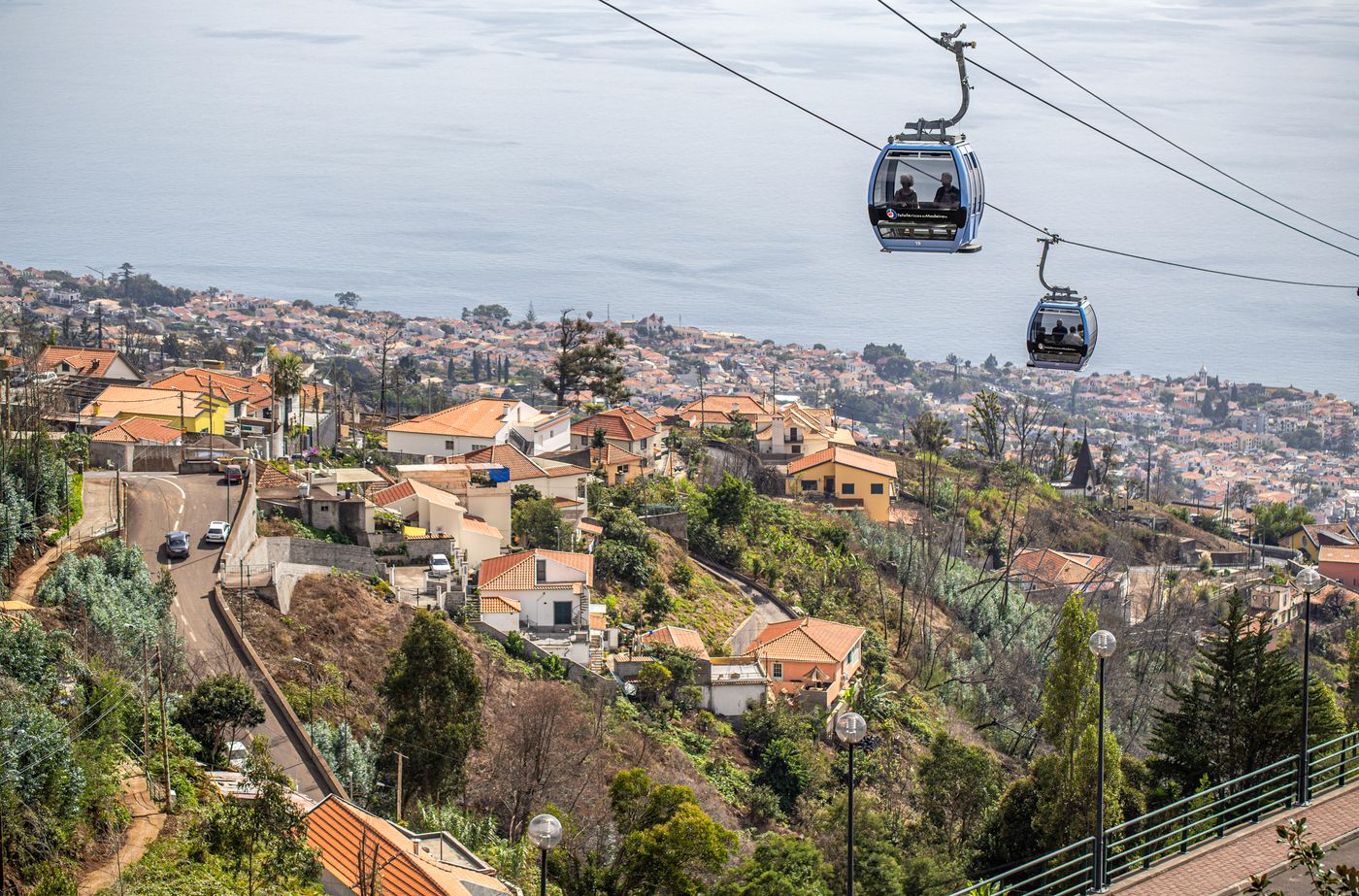
The Funchal cable car starts down by the seafront, in the Almirante Reis area near the old town, and floats you up over the rooftops to Monte in about fifteen minutes. It is not a thrill ride. It is a slow, quiet glide over terracotta tiles, narrow gardens, a deep ravine or two, and laundry lines, with the harbour widening out behind you the higher you go. On a clear morning you can pick out the breakwater, the cruise ships, the whole amphitheatre of the city stacked up the hillside.
I'd take it up rather than drive. Parking in Monte is awkward, the road switchbacks are tight, and a gondola gives you the best view of the whole excursion anyway. Go early if you can. Light is better in the morning, and the queues at the toboggan top haven't built yet.
The church at the top of the stairs
From the upper cable car station it is a short walk to the church that gives the village its name, Nossa Senhora do Monte. It stands at the top of a long, steep flight of stone steps, white-and-grey and twin-towered, and on the feast of the Assumption in mid-August it draws one of the biggest pilgrimages on the island, with some of the faithful climbing those steps on their knees.
There is a quieter piece of history inside. Karl I, the last emperor of Austria and king of Hungary, ended up in exile on Madeira after the First World War and the collapse of the Habsburg monarchy. He died here in 1922, of pneumonia, at not quite thirty-five, and he is entombed in a side chapel of this church. The Vatican beatified him in 2004, so the tomb now draws a steady trickle of pilgrims of its own. It is a strange thing to stumble on above a subtropical city: the resting place of a man who once ruled an empire of fifty million people, in a quiet church on a small Atlantic island.
A cable car, a sledge, and a dead emperor, all within a few hundred metres. Monte does not do things by halves.
Monte Palace, if you have an hour
A few minutes from the church is the Monte Palace Tropical Garden, built around an old hotel by the businessman José Berardo. It is a steep, layered garden, and you walk it on switchbacking paths past koi ponds, cycads and tree ferns, plants brought in from southern Africa and Asia, and a large collection of azulejos, the blue-and-white Portuguese tile panels, some of them centuries old and set into walls along the way. There is a museum on the site too, with minerals and African sculpture.
It takes a good hour to do properly, more if you stop, and the ground is uneven and sloping throughout, so it isn't a gentle stroll. If you only have time for either the garden or the church, and you lean toward plants and quiet over history, the garden wins. If you want to be back in Funchal for lunch, skip it and save it for another day.
And then the toboggan
Here is the part everyone photographs. The carros de cesto are wicker basket sledges, mounted on two wooden runners, with no engine, no brakes worth the name, and a cushioned seat for two. Each one is worked by two men, the carreiros, dressed in white shirts and trousers, straw boater hats, and rubber-soled boots that they use to brake and steer. They push, jog alongside, and lean the sledge through the bends as it slides down the steep paved streets on runners greased to run faster.
It starts in Monte, near the church, and drops about two kilometres down toward Livramento in around ten minutes. Using the camber of the road and the soles of their boots, the carreiros keep the thing pointed downhill and roughly in its lane, and on the steeper stretches it picks up a fair amount of speed. Part toboggan, part theatre. These men have done the run thousands of times and play it up for the camera, and the whole thing is good-natured.
None of this was invented for tourists. Sledges like these have been running since the 1850s, when they were everyday transport, a quick way to get downhill from the hill villages to the city before there were cars or a proper road, and goods came down the same way. Ernest Hemingway is endlessly quoted as having called it one of the most exhilarating experiences of his life, which may or may not be exactly what he said, but the line has stuck to the ride like grease to the runners.
What it actually is, and isn't
Two honest points. First, the toboggan does not take you back to Funchal. It ends partway down, around Livramento, and from there you take a taxi or a bus the rest of the way into town. There is usually a line of taxis waiting at the bottom precisely because they know you have nowhere else to go. Factor that into your time and your budget.
Second, it is touristy and it is not cheap for what it is, a ten-minute slide that ends short of where you started. If you arrive expecting a white-knuckle plunge you may find it tamer than the photos suggest. If you arrive expecting a hundred-and-seventy-year-old piece of working folklore that happens to be fun, you will get exactly that.
I think it is worth doing once. Not because it is a great ride in itself, but because it is so specific to this one island, kept alive by men who learned it from their fathers, and there is nothing else quite like it anywhere. Do it, take the photo, laugh at yourself, and then go find a proper lunch.
For opening hours and current cable car fares, the official island tourism site VisitMadeira is the place to check, and there's solid background on the village itself in the Wikipedia entry for Monte, on the sledges in the Carros de Cesto article, and on the emperor in the church in the page on Charles I of Austria. The Monte Palace garden has its own entry too if you want to read up before you climb.