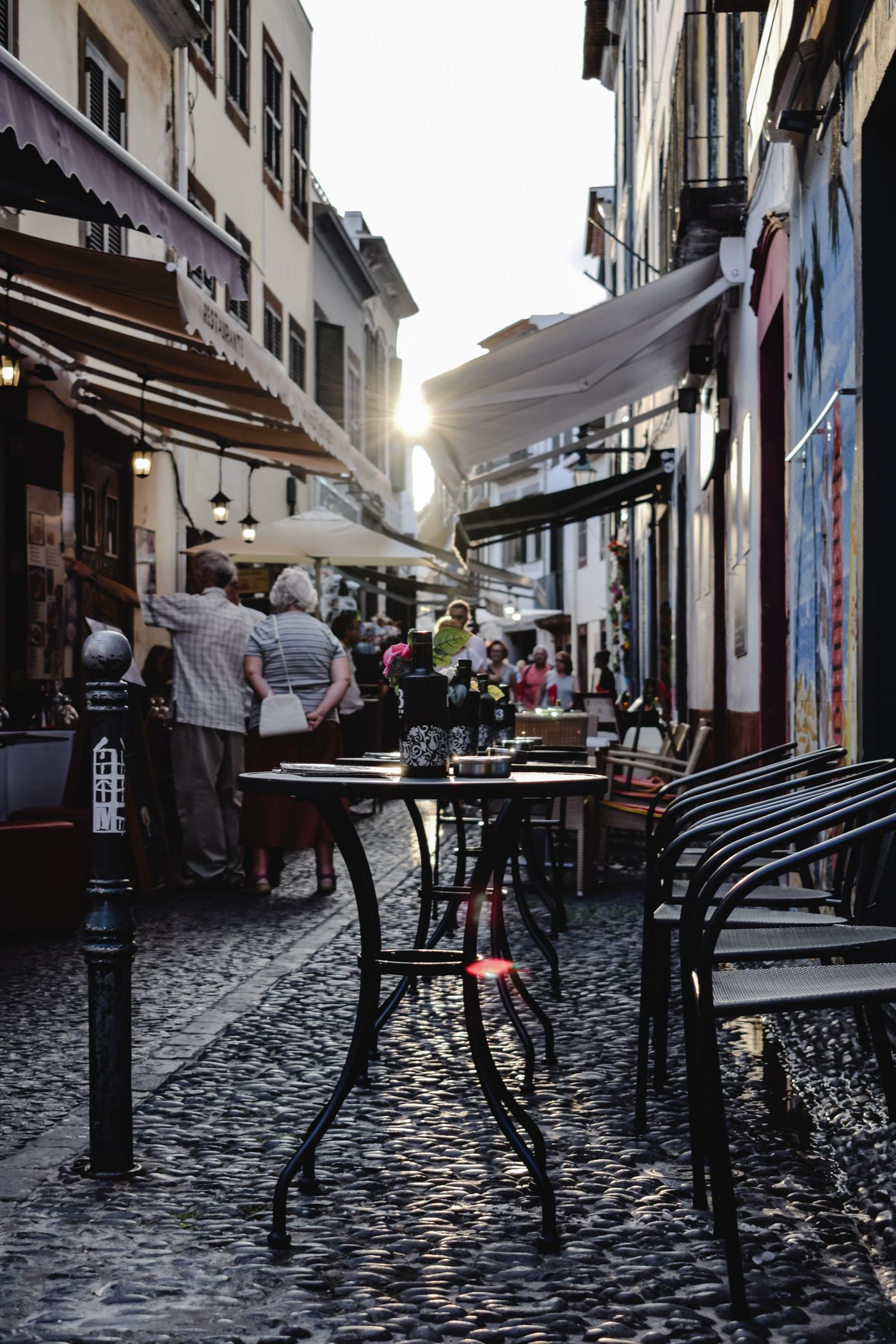
The Zona Velha late in the day, when the lanes belong to the tables. Earlier the same streets are nearly empty.
Funchal · 10 m
Funchal's old town and market
The capital is not a tick-list. Give it a slow morning on foot and it gives back far more than the cruise-day blur of the same streets at noon.
Most people meet Funchal at its busiest: mid-morning, cruise day, the painted doors photographed over the heads of forty other people doing the same. Funchal deserves better than that, and the fix is simple. Start early, walk a loose loop, and let one thing lead to the next instead of marching down a list. The old town, the market, the cathedral and the seafront sit within a fifteen-minute walk of each other. You can see all four before the day gets loud.
What follows is the order I'd take, not a rulebook. What matters is the rhythm, not the sequence.
Start at the market, before the buses
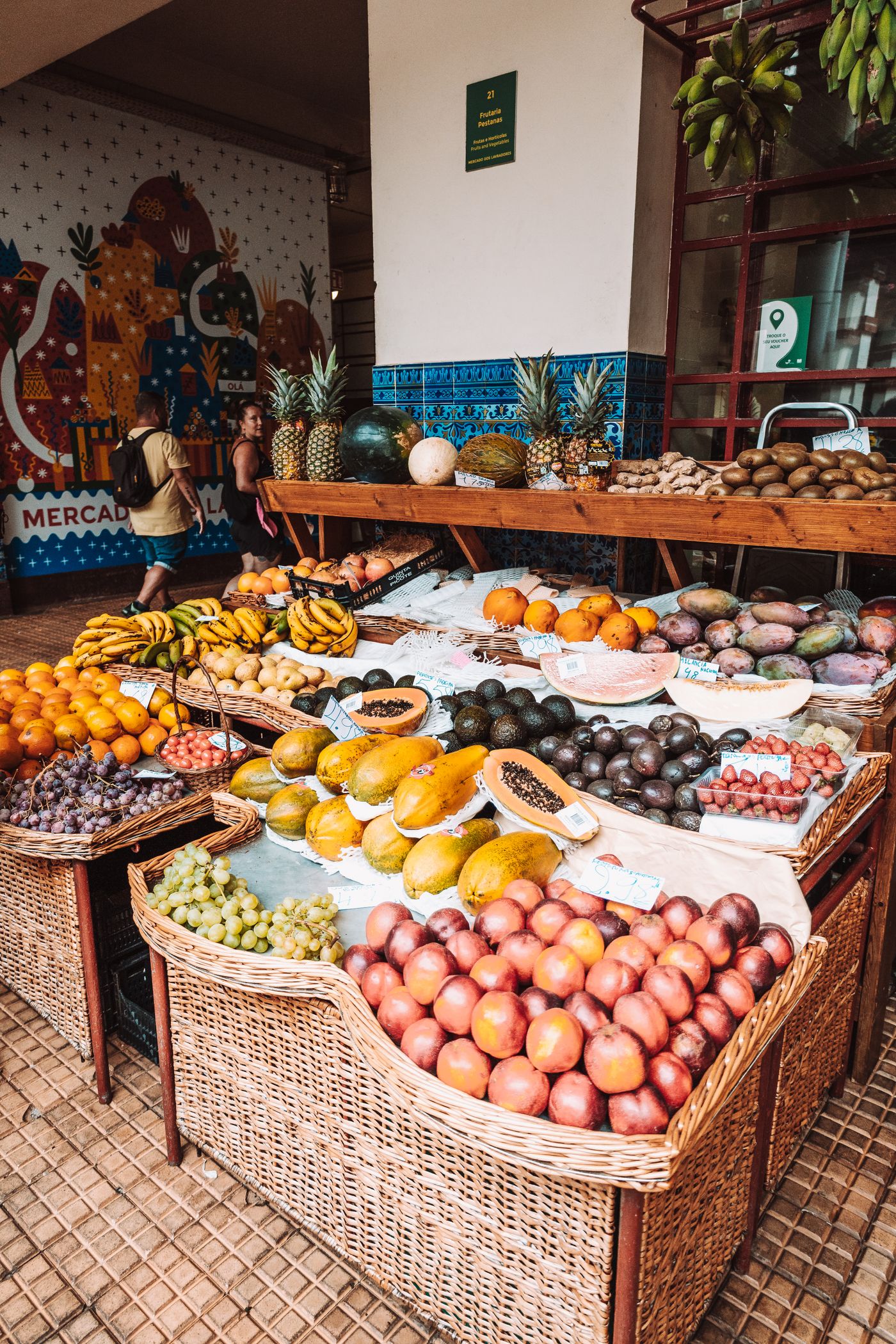
The Mercado dos Lavradores — the "workers' market" — opened on 24 November 1940, and the building still does most of the talking. It's an Art Deco shell wrapped in hand-painted azulejo tile panels, with an open central court and a gallery running around the upper level. Get there soon after it opens and you'll catch the part tourists rarely see: deliveries coming in, flower sellers in the red-and-black regional dress setting out lilies and birds of paradise, vendors arguing prices in fast Madeiran Portuguese.
Upstairs is the postcard. Pyramids of custard apple (the local anona), half a dozen kinds of passionfruit, the green knobbly cones of monstera deliciosa, mango, guava, tamarillo. It is genuinely beautiful, and it's also where the one piece of friction lives.
Then go down to the fish hall. This is the part I'd actually send people to. On the lower level, under the high windows, slabs are stacked with the long, ink-black espada — black scabbard fish, an ugly deep-water creature with needle teeth that Madeira somehow turned into a signature dish. Tuna comes through here too, cut to order. It's working, slightly chaotic, and it smells like a real market should. Nobody is selling you a fruit box down here.
The painted doors of the Zona Velha
From the market it's a two-minute walk into the Zona Velha, the old town that fans out toward the sea. The spine of it is Rua de Santa Maria, one of the oldest streets in the city, and the thing it's known for is the doors.
In the early 2010s a project called Arte de Portas Abertas — "the art of open doors" — invited artists to paint the street's old doorways. Some are gorgeous, some are odd, a few are genuinely strange, and that mix is the charm. A faded wooden door becomes a portrait, a shoal of fish, a surreal little scene. Walk the whole length slowly and read the doors like a gallery hung along a working street, because that's what it is — people still live and run shops behind them.
The doors aren't a museum. They're somebody's front entrance that happens to be a painting, which is exactly why they work.
By evening this whole quarter turns into the city's dinner table. Tables and chairs spill out of the restaurants and fill the lanes, and waiters work the cobbles with menus. That's the right time to eat here, not the right time to look at the doors — earlier in the day the same streets are quiet enough to actually see them.
A detour to the little fort
Where the old town meets the water you'll find the Forte de São Tiago, a small ochre-yellow fortress begun in the late 1500s to defend the bay against pirates. It's modest — this is not a vast hilltop castle — but the position is the reward. Its ramparts give you the sweep of the seafront in one direction and the tumble of old-town rooftops in the other. It's worth the ten minutes even if you don't go inside.
The cathedral most people walk past
Cut back inland toward the centre and you reach the Sé, Funchal's cathedral, built in the late fifteenth and early sixteenth centuries under King Manuel I. From outside it's almost plain, dark volcanic stone, easy to walk past. Step in and look up.
The ceiling is the thing: a Mudéjar-inspired wooden roof in Madeiran cedar, worked in an intricate geometric knotwork pattern that you don't expect from the sober exterior. There are carved choir stalls and a quietness that makes a good pause between the noise of the market and the glare of the seafront. Entry is free; it's an active church, so keep it low-key if a service is on.
End at the water
From the cathedral it's a short downhill walk to the seafront. Avenida do Mar runs along the harbour, and the promenade past the marina is the city's exhale — bobbing yachts, the cruise pier, an espresso at a kiosk, the line of hills rising straight up behind the town.
This is also where the cable-car base station sits, the teleférico that climbs to Monte high above the bay. You don't have to ride it today; it's just useful to clock where it is, because Monte and the wicker-toboggan run are an easy half-day on their own. For now, the marina is a fine place to stop, sit, and feel slightly smug that you saw the good version of Funchal before the crowds did.
Madeira wine, if the morning ran long
One more thread worth pulling: the wine lodges. Madeira — the fortified wine the island is named for, or rather the wine named after the island — is tasted at a handful of historic lodges in town. You can sit for a flight of dry to sweet styles, from a crisp Sercial to a treacly Malmsey, and the better lodges walk you through how the wine is deliberately heated and aged, which is the whole trick of it. It's an indoor, sit-down counterpoint to a morning on your feet, and a fair excuse to keep the slow pace going into the afternoon.
For opening hours, seasonal events and the official line on what's on, the regional tourism site Visit Madeira is the place to check before you go.
None of this needs booking, none of it needs a guide, and most of it is free. Walk it in the morning, eat in the lanes at night, and Funchal stops being a stopover and starts being a place.