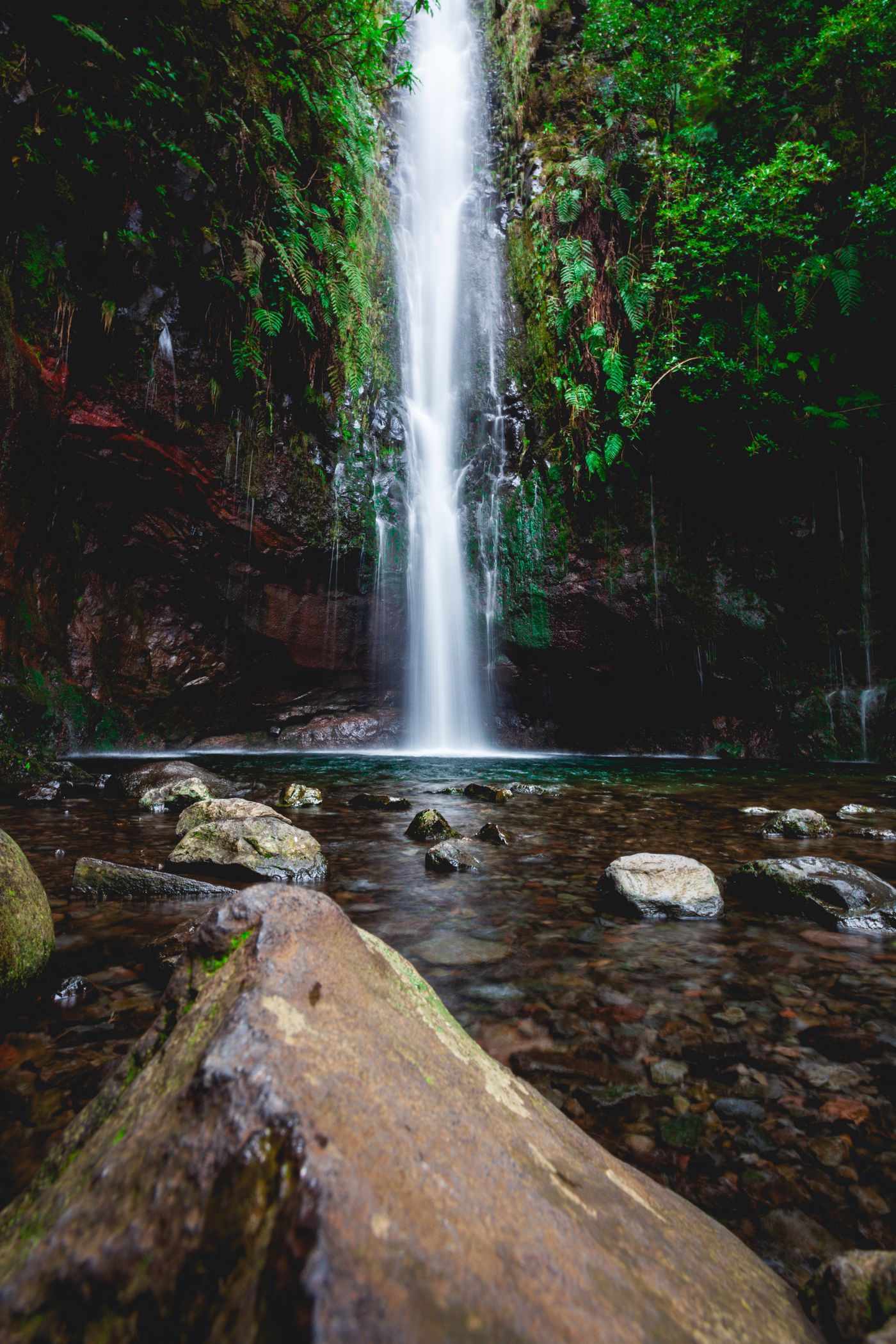
The amphitheatre at the end of the 25 Fontes levada. Get here before the first shuttle empties out and you might have it to yourself for ten minutes.
Levada · 1280 m
25 Fontes and Rabaçal
This is the walk everyone does, and the one everyone tells you to skip because everyone does it. Both camps are wrong. Go early, take the right turning at the bottom, and it earns its reputation.
The 25 Fontes walk starts in a place that feels like the wrong place. You drive up onto Paúl da Serra, the big flat plateau that sits across the western middle of the island, and the green folds of Madeira give way to open moorland, sheep, and often a wall of fog. At the rim there's a small car park, a café-kiosk, and a road dropping away below you into the trees. That road goes down to Rabaçal, and the trailhead is at the bottom of it.
You cannot drive down. The access road is narrow, steep, and closed to private cars, so you have two honest options: take the official shuttle van that runs the road in a few minutes, or walk it. For most people the shuttle is the sensible choice, and it costs a few euros each way. Walking the road down takes maybe twenty-five minutes and is easy; walking it back up at the end, after several hours on your feet, is the part people underestimate. Reckon on a steady, unshaded climb of around 300 metres in height. Plenty of perfectly fit walkers do it and grumble the whole way.
At a glance
- Distance
- ~9 km, depending on whether you add the Risco fall and how you loop it
- Time
- 3–4 hours walking, plus waiting time at the narrow sections
- Grade
- Moderate. Mostly flat along the levada, with some exposed ledges and steps down to the pool
- Getting down
- Official shuttle van from the top car park, or walk the road (a stiff climb back up)
- Start
- Rabaçal, reached from the Paúl da Serra plateau in the west (E.R. 105)
What you actually walk
From the Rabaçal house at the bottom of the road, the official PR6 route follows the Levada das 25 Fontes — the channel of the "Twenty-Five Fountains." A levada is a hand-cut irrigation canal, and the path runs alongside it, so the walking is gentle and the gradient is close to nothing. You are mostly inside laurisilva, the ancient laurel forest that covers the island's wet northern flanks and is a UNESCO-listed World Heritage forest. Ferns, moss, tree heath, the smell of wet leaf litter. It is genuinely lovely, and on a clear morning the light comes through the canopy in slabs.
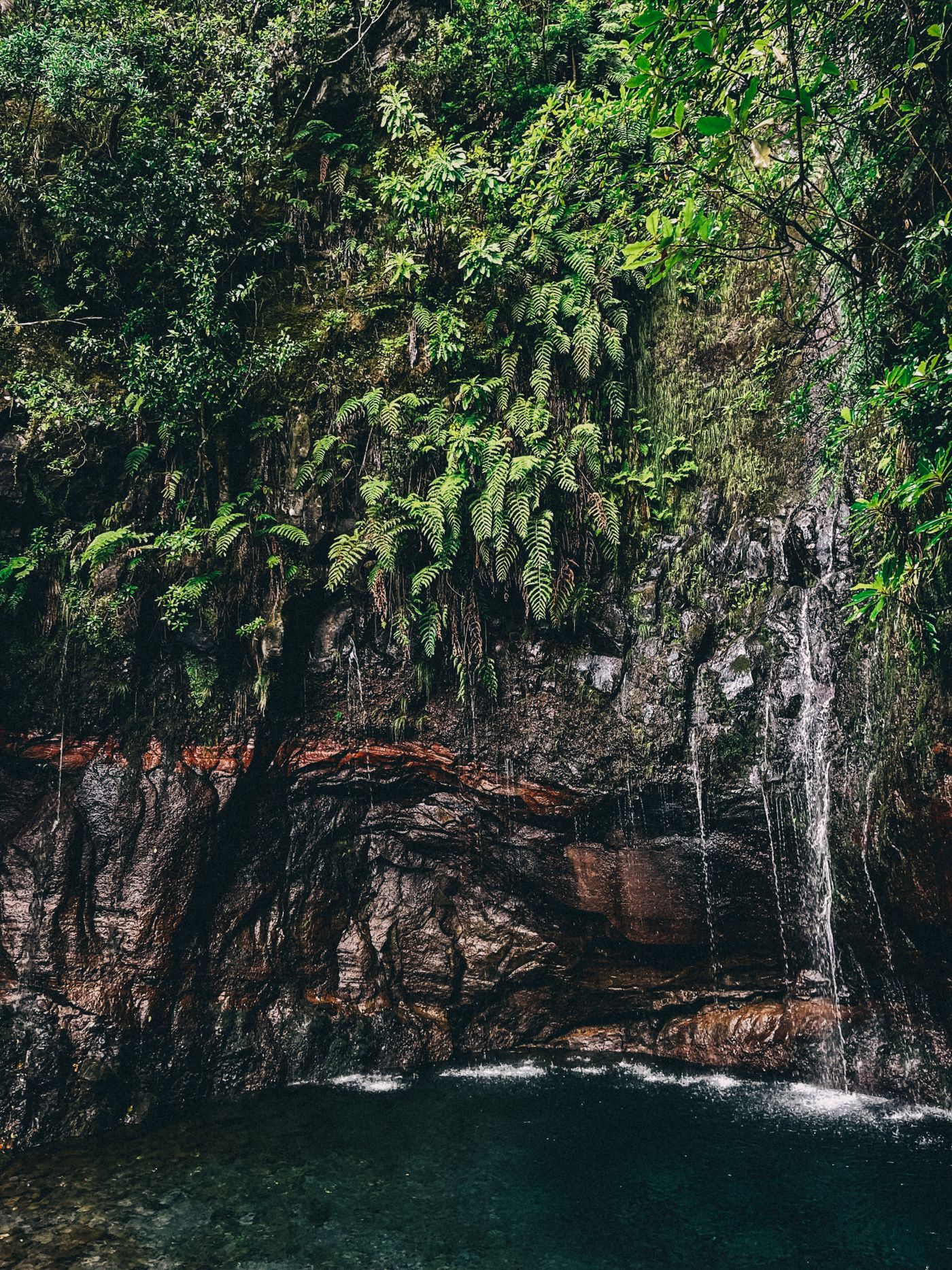
At the far end the path opens into a green bowl where the water arrives. Roughly two dozen springs and trickles seep out of the rock and feed a shallow lagoon — that is where the name comes from. According to the regional forestry service, the water draining off Paúl da Serra surfaces here through those springs, which is why the basin never seems to empty even in a dry August. It is not a single dramatic curtain like some of the island's bigger falls. It is quieter than that, and somehow better for it.
Don't skip the Risco
Most people pair 25 Fontes with the Levada do Risco, and you should. Both trails share the same start at Rabaçal and run almost parallel for a while before splitting. The Risco branch is short — twenty minutes or so out from the junction — and it ends at the Risco waterfall, a tall single drop that plunges off the cliff into a gully. Adding it turns the day into a proper outing rather than a there-and-back, and the junction is signposted, so you won't get lost. If you only have legs for one, the 25 Fontes pool is the headline; the Risco is the encore that takes barely any extra effort.
The walk isn't busy because it's overrated. It's busy because it's good, and everyone has worked that out.
The crowds, and how to dodge them
This is the most popular levada walk on the island. Coach groups and rental cars converge on that top car park from mid-morning, and the trail has pinch points: narrow ledges where the levada hugs a cliff, a single-file tunnel, and steps down to the pool where only a few people fit at once. By 11am you can find yourself standing on a ledge waiting for a queue of forty to file past in the other direction. None of it is dangerous if you keep your wits, but it's the opposite of the peaceful forest morning the photos promise.
Fixing it is simple and slightly annoying: be on the first shuttle, or come in the late afternoon when the groups have left. I walked it once arriving at the pool a little after eight and had the springs to myself for a while before the first wave came down. That, against a midday visit, is the difference between two completely different walks.
If the weather looks grim up top
- Fog
- Paúl da Serra has more than 240 foggy days a year. Cloud at the car park doesn't mean cloud the whole walk — you often drop below it into the forest — but check before committing.
- Cold
- The plateau sits around 1,500 m and can be 10°C colder than Funchal, with wind. Bring a layer even in summer.
- Closures
- Levadas close after landslips or heavy rain. Check the official status the night before, not at the trailhead.
What to bring, and the small stuff
Shoes with grip matter more than anything: the levada path is often wet, and the stone gets slick where the water spills over. Trainers are fine in the dry, but I wouldn't wear smooth-soled ones. Take water — there's a kiosk at the top car park but nothing reliable on the trail — and a layer, because the forest is cool and damp even when the coast is baking. A head for the exposed sections helps; in a few places the drop on the levada side is real, and there's a cable to hold but no continuous railing.
Practical bits people get caught out by: the top car park fills early in summer and on weekends, so an early start solves two problems at once. The shuttle runs on its own rhythm rather than a fixed timetable, and the queue for it can build at the end of the day when everyone finishes together — another vote for going early. And the plateau weather is its own thing entirely; you can leave Funchal in shorts and meet sideways drizzle at Rabaçal twenty minutes later.
So is it worth the hassle?
Yes, with the caveat that the hassle is real and you have to plan around it. The shuttle, the plateau fog, the queues at the narrow bits — none of that is in the brochure shot of the green pool. But the walk through the laurel forest is one of the best easy hikes on the island, the springs are quietly extraordinary, and the Risco fall rounds it off. Go early, sort out the shuttle or steel yourself for the climb back up, and you'll understand why this is the one walk almost everyone who comes to Madeira ends up doing.
For the official route description and current conditions, the island's tourism board keeps a PR6 walking-route page with distance and timing, and the regional forestry service (IFCN) publishes the list of classified trails and their open/closed status — worth a look the evening before, since closures after rain are common. For background on the plateau the water comes from, the Paúl da Serra entry covers the geography and that famous fog.
Once you've got the rhythm of a levada day, the Caldeirão Verde walk in the north makes a strong second outing — longer, wilder, and with proper tunnels.